

Slang can both connect and divide generations. It’s a tool for identity and belonging, but it also creates communication barriers, especially between Gen Z, Millennials, and Gen X. Here’s why:
- Slang evolves fast: 89% of Americans learn slang online, making it hard for older generations to keep up.
- Workplace challenges: 30% of Gen X and 25% of Gen Z struggle to understand colleagues from other age groups.
- Family misunderstandings: Parents often take slang literally, leading to miscommunication at home.
Key insight: Each generation uses slang differently - Gen Z creates it on TikTok, Millennials adapt it at work, and Gen X learns it from younger family members. Bridging these gaps requires understanding, not imitation, to improve relationships and communication.
Want to decode generational slang and learn how to connect better? Let’s dive in.
How Different Age Groups Use Slang
Current Gen Z Slang Terms
Gen Z has a distinct connection to slang, shaped by growing up with the internet at their fingertips from a young age [4]. Their vocabulary is heavily influenced by online culture, memes, and platforms like TikTok [1]. What makes their slang stand out is how quickly it changes and its diverse roots, including significant influences from African-American Vernacular English (AAVE) and ball culture [3].
Interestingly, not all Gen Z slang is brand-new. Some terms have been passed down from earlier generations. For instance, phrases like "bet" and "cray" were popularized by millennials, while gaming terms such as "KDA" and "pwn" go back even further. "RPG" has its roots in Gen X's era, specifically during the rise of Dungeons and Dragons [4].
Slang's Role in Group Belonging
Each generation has its own way of picking up and using slang, which helps define their identity and sets them apart:
| Generation | How They Learn Slang | Key Behavior |
|---|---|---|
| Gen Z | TikTok | Rapidly creates and spreads new slang |
| Millennials | YouTube | 28% adopt Gen Z slang to connect at work |
| Gen X | Younger family members | Struggles the most with understanding slang at work |
These habits not only reinforce generational bonds but also create natural language gaps between groups.
How Older Generations View Slang
Older generations often approach modern slang with a mix of curiosity and skepticism. Nicholas Graham, a history teacher, explains:
"Older generations should not be adopting the slang of younger generations. Leave them alone. It's not for you. The reason that a generation acquires and develops its own slang is to mark itself off from [other groups], almost as an act of rebellion. So to hear older people speak, it would be really quite sad. I think I'd come off as a bit of an idiot." [2]
Adding to this, math teacher Matthew Bartha highlights why younger generations create their own slang:
"I feel like younger generations always [want to] look like they're cool - they want to look separate, different or unique. So, they form their own ways of communicating based on their culture and whatever else is going on at the time." [2]
Experts agree that older generations should focus on understanding, rather than using, younger generations' slang. This approach can improve communication without undermining the unique linguistic identity of each group. However, these differences in language often create challenges, especially in cross-generational interactions at home or in the workplace.
How Slang Affects Cross-Generation Communication
Common Communication Breakdowns
Research reveals that nearly one-third of Gen X workers and 25% of Gen Z workers face challenges understanding their colleagues [1]. At home, parents often misinterpret slang by taking it literally, leading to misunderstandings about their children's emotions and intentions [5].
Here’s a breakdown of common communication problems across various settings:
| Setting | Communication Challenge | Impact |
|---|---|---|
| Workplace | Misinterpretation of casual language | Delays in project timelines and knowledge sharing [7] |
| Family | Literal understanding of modern slang | Less open communication about personal thoughts [5] |
| Mentorship | Struggles with digital-native language | Reduced ability to provide effective guidance [8] |
These issues influence both professional relationships and family connections.
Slang's Effect on Work and Family
Misunderstanding workplace slang can directly impact productivity. As Min explains:
"Some of our team thought Dani and Santosh were really rude, too direct or not serious enough and would complain about their business communication being unprofessional" [7].
With Gen Z expected to make up over a quarter of the workforce by 2030 [7], bridging generational communication gaps is increasingly important. At home, parents often find it hard to keep up with fast-changing slang, leaving Gen Z feeling unheard or misunderstood [5]. Interestingly, 82% of young people say they prefer mentors who can connect on topics beyond just work [9].
Jamie Johnson emphasizes the importance of empathy and adaptability in overcoming these challenges [6]:
"If anything, slang reminds us to be flexible and to really focus on trying to understand where people are coming from. Are we willing to move and flex with the language as it grows?" [6].
When communication breaks down, it can lead to stress and hinder personal and professional development. For instance, 46% of Gen Z report experiencing frequent stress [9].
sbb-itb-ca058e4
Ways to Reduce Slang-Based Misunderstandings
Staying Updated on New Terms
Slang evolves quickly, and keeping up can feel overwhelming. Digital platforms are a great way to stay in the loop. For instance, Gen X often turns to younger family members for explanations, Millennials lean on YouTube, and Gen Z frequently uses TikTok [1]. Tools like the Gen Z Slang Directory make it easier to understand these changes and stay informed.
Exploring the Gen Z Slang Directory
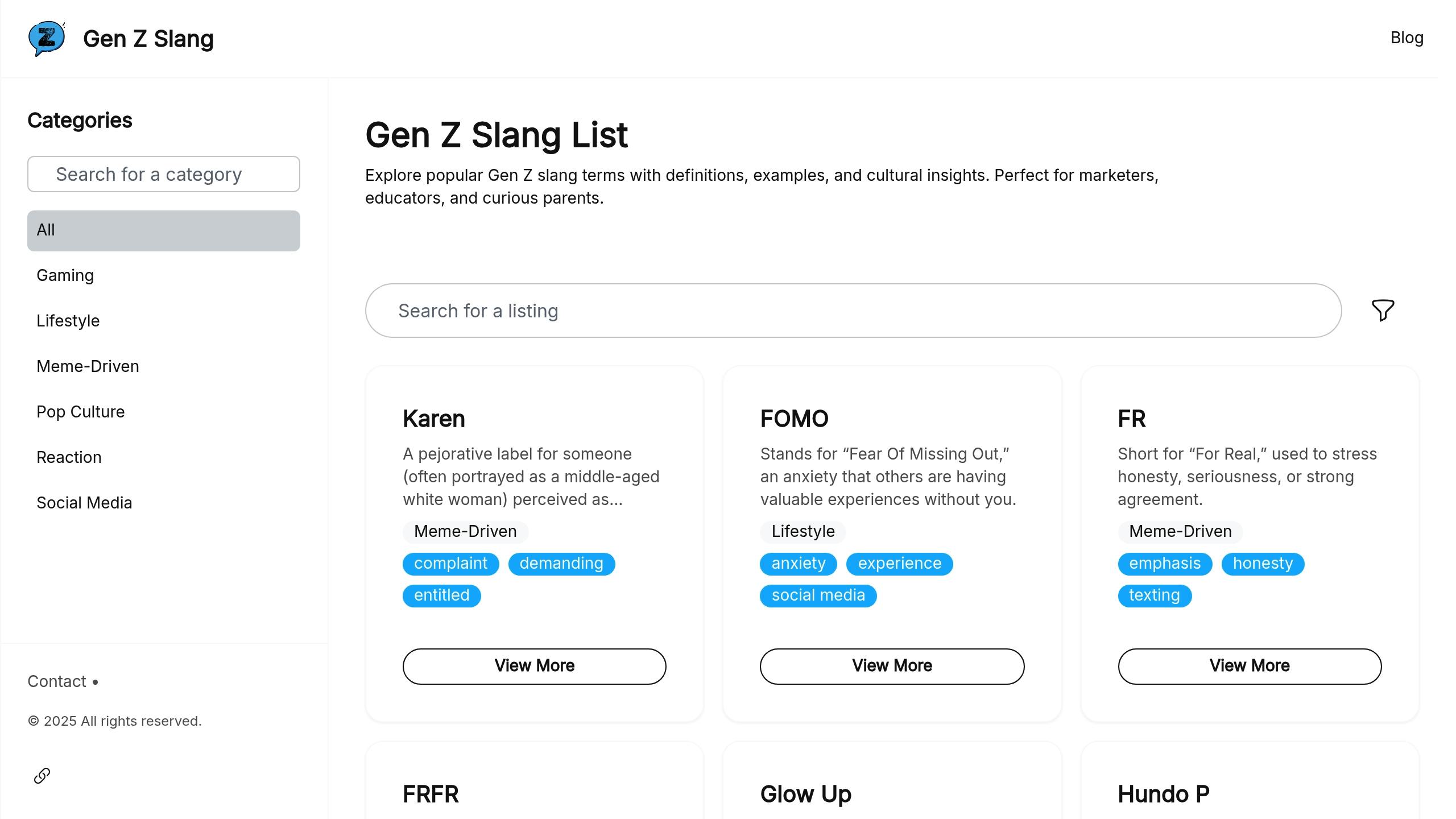
The Gen Z Slang Directory (https://genzslanglist.com) is a helpful resource for educators, parents, and professionals. It provides clear definitions, cultural insights, and real-world examples. Stacey Clapp, Director of Strategic Communications, emphasizes the importance of understanding in communication:
"The key to healthy partnerships in team environments is more than communication: it's comprehension as well" [11].
With this knowledge, you can start closing communication gaps and fostering better conversations.
Encouraging Cross-Generational Conversations
Bridging generational communication gaps requires intentional effort and varied approaches. Here are a few strategies to help foster better understanding:
- Use different communication channels like email, video calls, or messaging to suit individual preferences [11].
- Schedule one-on-one meetings or mentoring sessions to build trust and create space for open dialogue [11].
- Develop clear communication guidelines, which have been shown to reduce misunderstandings by 25% [11].
Recognizing the cultural significance of slang can also strengthen intergenerational respect [10]. Since slang changes rapidly with trends on social media [10], staying engaged with younger family members or colleagues shows a commitment to meaningful communication [3].
How to Communicate Across Generations Especially Gen Z
Conclusion: Improving Cross-Generation Communication
Slang plays a dual role - it strengthens group identity but can also create communication barriers. Addressing these challenges is key to improving collaboration between generations. For instance, Gen X often struggles to understand younger colleagues, while Gen Z faces similar issues with older coworkers [1].
Key Takeaways
Successfully communicating across generations requires open dialogue and an appreciation for different communication styles. Each generation picks up slang differently: Gen X often learns from younger family members, Millennials turn to platforms like YouTube, and Gen Z gravitates toward TikTok. Interestingly, 28% of Millennials use Gen Z slang to better connect with younger peers [1].
These findings suggest that organizations need to rethink how they support communication. Providing training on modern tools, setting clear communication expectations, and tailoring approaches for different groups can make a big difference.
Ultimately, effective communication is about more than just words - it’s about creating meaningful connections. This ties into a recurring theme:
"It's a generational cycle. Parents in the '50s didn't understand their kids, and now we're in the same boat."